
Personal Brand vs Corporate Brand
What’s the Difference and Which Is Right for You?
If you’re trying to work out whether your business needs a personal brand or a corporate brand, you’re not alone.
It’s one of the most common branding questions business owners ask, especially when they start growing, hiring, or thinking more seriously about how they want to be seen.
The short answer?
Neither is automatically better. It depends on your business model, your goals, how visible you want to be, and whether the business needs to grow beyond you.
In this article, I’ll break down the difference between personal branding and corporate branding, when each one makes sense, and how to decide which is right for your business.
What is a personal brand?
A personal brand is a brand built around a person.
It is shaped by your personality, reputation, expertise, values, voice and visibility. People connect with you, not just the business name.
This kind of brand is common for:
coaches
consultants
speakers
creators
educators
service providers
experts who are the face of their business
With a personal brand, trust is built through the individual behind the business.
Think:
your name
your story
your face
your point of view
your expertise
If people are buying because of you, your reputation, your personality or your approach, you are likely building a personal brand.
What is a corporate brand?
A corporate brand is a brand built around the business itself rather than one individual.
The company becomes the focus. The name, identity, positioning, messaging and customer experience are designed to stand on their own, even if the founder is not front and centre.
This kind of brand is common for:
agencies
product-based businesses
larger service businesses
teams
companies planning to scale
businesses that want to be sellable without relying on one person
With a corporate brand, trust is built through the business identity, brand experience, team, product or service delivery rather than the personal visibility of one founder.
If people are buying because of the business, not just the person behind it, you are likely building a corporate brand.
Personal branding vs corporate branding: the key difference
The biggest difference comes down to this:
A personal brand is built around a person.
A corporate brand is built around a business.
That affects everything from:
how people discover you
how trust is built
how content is created
how easy it is to grow a team
how dependent the business is on your personal visibility
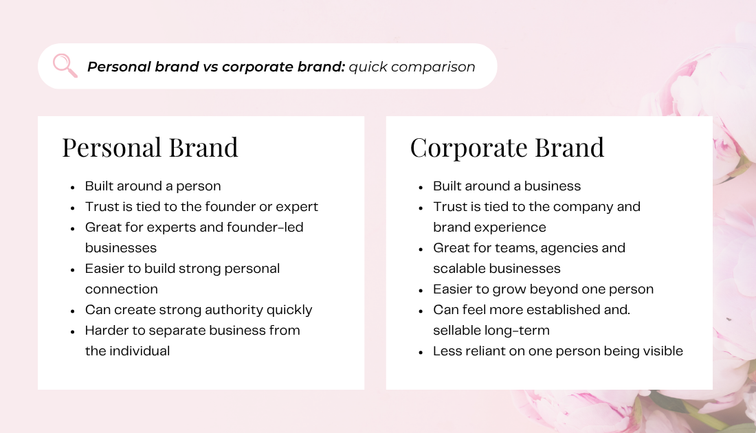
Quick comparison:
• Personal brand: built around a person, trust is tied to the founder, ideal for experts and founder-led businesses.
• Corporate brand: built around a business, trust is tied to the company, ideal for teams and scalable businesses.
When a personal brand makes more sense
A personal brand often makes the most sense when:
1. You are the business
If clients are hiring you for your thinking, experience, creativity or expertise, a personal brand is often the strongest fit.
2. Your visibility drives trust
If your audience needs to hear from you, see you, or connect with your story before they buy, a personal brand can help build that trust faster.
3. You want to grow your authority
Personal brands work especially well for speakers, coaches, consultants, educators and experts because they allow you to build recognition around your name and point of view.
4. Your offer is closely tied to your expertise
If people are buying your knowledge, method or leadership, personal branding can be a smart choice.
When a corporate brand makes more sense
A corporate brand often makes more sense when:
1. You want the business to grow beyond you
If you want to build a business that does not depend entirely on your face or personal visibility, a corporate brand can create more freedom.
2. You have or want a team
If multiple people are involved in delivering the work, a corporate brand can feel more scalable and cohesive.
3. You want the business to be more sellable
A business that relies too heavily on the founder’s personal profile can be harder to step away from, scale or sell later.
4. You want to build a bigger brand ecosystem
If your business could expand into products, programs, services, events or multiple brand extensions, a corporate brand may give you more room to grow.
Can you have both a personal brand and a corporate brand?
Yes — and many businesses actually need both.
This is often the smartest option.
For example:
the founder builds visibility, trust and authority through a personal brand
the business builds credibility, scalability and structure through a corporate brand
In this setup, the personal brand helps attract attention and connection, while the corporate brand creates a more established business presence around it.
This can work really well if:
you want to be visible but not be the only thing holding the business up
you want to build founder authority without limiting future growth
your audience buys into you first, but eventually buys from the business
For many modern businesses, it is not a case of personal brand or corporate brand.
It is often about deciding how the two should work together.
So which one is right for you?
Here are a few simple questions to ask yourself:
Do people buy because of me, or because of the business?
If the answer is “because of me”, a personal brand may need to lead.
Do I want the business to grow without me being at the centre forever?
If yes, a corporate brand may need to be stronger.
Do I want to speak, teach, create content or build thought leadership?
A personal brand can be a major asset here.
Am I building something that could eventually become bigger than me?
If yes, corporate branding probably matters more than you think.
Would a blend of both make more sense?
For many business owners, the answer is yes.
My take as a brand designer
In my experience, a lot of business owners get stuck because they think they have to choose one or the other too early.
But often the better question is:
What should lead right now, and what should I build for later?
If you are an expert, consultant, speaker, educator or founder, your personal brand may be the strongest trust-builder in the early stages.
But if you want the business to grow, become more sellable, feel more established, or work beyond your personal visibility, then your corporate brand needs attention too.
The goal is not to force yourself into one box.
The goal is to build a brand structure that supports the business you actually want.
Final thoughts: personal branding vs corporate branding
If you are deciding between personal branding and corporate branding, the answer comes down to how you want your business to be seen, how you want it to grow, and how much the brand needs to rely on you personally.
Choose a personal brand when:
your expertise is the main selling point
your visibility builds trust
you want to grow your authority
Choose a corporate brand when:
you want to scale beyond yourself
you want the business to feel more established
you want a brand that can grow independently of one person
And if both matter? Build both intentionally.
Need help deciding whether your business needs a personal brand, a corporate brand, or both?
If you’re not sure whether your business needs a personal brand, a corporate brand, or a combination of both, I can help.
I work with small businesses, founders, experts and teams to create more polished, strategic and cohesive brands — including Canva setup, brand design, visual systems and stronger on-brand content.

Hey there!
I’m Rebecca Flint - Canva Verified Expert, brand designer, speaker and visual strategist helping businesses create polished, on-brand content and stronger visual systems.